
Peter Wingrove Peter Wingrove    @SmartAsDaddy

Smart As Daddy

Stage IV prostate cancer. Dad. Husband. Son. Still here.
Sharing what nobody tells you.

4,056 0.12

PSA in 12 months    no active tumours    the dragon is sleeping

4,056
PSA at diagnosis
Normal is under 4. Mine was over a thousand times that — found late, because I had to fight for the test.
0.12
PSA today
Twelve months of treatment. No active tumours. The dragon is sleeping.
52
Age at diagnosis
My GP didn’t think I needed a PSA test. I had to insist. That insistence saved my life.
7–10
Years now projected
My original prognosis was 2–4 years. Triplet therapy has potentially changed everything.
Read My Story Sign the Petition
The Campaign

The case for screening. In numbers.

Prostate cancer is now the most commonly diagnosed cancer in the UK. There is no national screening programme. These numbers explain why that has to change.

1 in 2
UK prostate cancer diagnoses are made at stage 3 or 4 — when the cancer has already spread.
Prostate cancer is curable if found early. A national screening programme finds it early.
NHS Digital, Cancer Registration Statistics England 2022, Commons Library Dec 2024
#1
Most diagnosed cancer in England
Prostate cancer overtook breast cancer as the most commonly diagnosed cancer in England in 2022 — and it’s still number one.
Prostate Cancer UK / NHS England
55,900
New UK cases a year
Around 150 new diagnoses every single day in the UK. Every day without screening is another day men are found too late.
Cancer Research UK
12,300
Deaths a year
34 men every day. One every 43 minutes. A national screening programme could change this — because most of these deaths are preventable.
Cancer Research UK
~100%
Survival at stage 1
The same disease that kills 12,300 men a year is almost entirely survivable — when found early enough. That’s the whole argument for screening.
Cancer Research UK
4.7×
More likely to lose your job
Men diagnosed at stage IV are nearly five times more likely to lose their jobs. Late diagnosis costs far more than your health.
LAPCD study, UK
No invite
No screening letter
Unlike breast, bowel, or cervical cancer, men receive no invitation for routine prostate screening on the NHS. Nothing arrives. Nothing prompts the conversation.
NHS / UK NSC
1 in 4
Lifetime risk for Black men
Double the average lifetime risk — yet the 2025 NSC draft recommendation excluded this group from targeted screening entirely.
Prostate Cancer UK
1 in 8
Men will be diagnosed
In the UK. Most will have no symptoms in the early stages. By the time something feels wrong, it may already have spread.
Prostate Cancer UK
45+
You can ask for a test
Men aged 45 and over can request a PSA blood test from their GP — even without symptoms. Most men don’t know this. Now you do.
NHS / PCRMP
£27
Cost of a PSA test
The test that found my cancer. The test I had to argue for. Twenty-seven pounds. Ask your GP for one today.
NHS reference cost
2025
NSC review year
The UK NSC reviewed the evidence. Their draft covers only a small subset of men with BRCA gene variants — leaving the wider population without a systematic invitation to be tested.
UK NSC, 2025
TRANSFORM
The trial to watch
A major UK study testing PSA combined with MRI as the basis for national screening. If it works, it could change everything. Results expected over the coming years.
TRANSFORM Trial / NHS England
7–10 yrs
My time
What my doctors say I may have. I’m spending every day of it fighting for screening. If I’d been found at stage 1, I wouldn’t be racing against the clock.
Peter Wingrove, diagnosed 2025
The Campaign

No man should have to argue for this blood test.

“My GP didn’t think I needed a PSA test. I was 52 with a swollen abdomen, and he thought it was colorectal. I had to insist on the blood test. That insistence saved my life.”

Peter Wingrove — January 2025

The UK screens routinely for breast cancer, bowel cancer, and cervical cancer. Women receive letters. Men receive nothing.

Prostate cancer is now the most commonly diagnosed cancer in the UK. A man dies from it every 43 minutes. And yet there is still no national screening programme — leaving men, GPs, and families to navigate a system that was simply not designed to catch this disease early.

The UK National Screening Committee reviewed the evidence in 2025 and issued a draft recommendation for targeted screening — but only for a small group of men with confirmed BRCA gene variants. The wider population remains without a systematic invitation to be tested.

The TRANSFORM trial is currently testing whether combining PSA with MRI could provide a safe, accurate foundation for national screening. The evidence is being built. The political will needs to follow.

I’m campaigning for a UK Parliament petition that calls for a national prostate cancer screening programme. Sign it. Share it. Tell every man you know it exists.

The TRANSFORM Trial: A major UK research programme testing PSA + MRI for better screening. If successful, it could provide the evidence base for a full national programme. In the meantime, men aged 45+ can request a PSA test from their GP — but most don’t know this.

Sign the Petition

We’re calling on the UK Government to introduce a national prostate cancer screening programme. Every signature matters. If we reach 100,000, Parliament must debate it.

Sign Now on Parliament.uk
petition.parliament.uk/petitions/751472
My Story

The Dragon Is The Story.

This isn’t really about me.

I know. That’s a strange thing to say when my name is in the URL and my face is on the screen. But stay with me.

There is a dragon. He lives inside me. Stage IV metastatic prostate cancer — spine, lymph nodes, chest, hips. PSA of 4,056 when they found him. Over a thousand times what it should be. He had been growing quietly for years while a GP told me I was too young to worry about it.

Right now, the dragon is sleeping. Not gone. Not beaten. Sleeping — held down by a combination of hormones, targeted therapy, and seven brutal rounds of chemotherapy. That distinction matters enormously. This is not a recovery story. It is a living-with-it story. A keeping-him-down-long-enough-to-matter story.

And the reason I’m telling it isn’t to ask for your sympathy.

It’s because this dragon doesn’t only live in me. He lives in one in eight men in the UK. He’s patient. He’s quiet. And far too often, by the time anyone knows he’s there, he’s already won ground he should never have been allowed to take.

I spent twenty years in charity and leadership — raising money, building programmes, running organisations. I know how systems work. I know how change happens. And I know that the most powerful tool in any campaign is a story that makes the abstract feel real.

So that’s what I’m building here. Not a sympathy platform. A map. A field report from inside the fight — so that other men know what this creature looks like, how it moves, where the opportunities are, and what the cost of missing them is.

The dragon isn’t slayed.
But he’s sleeping.
And I’ve got things to tell you while he is.
Want the full story? The numbers. The treatment. The hard parts.
Read the full story ▼

In January 2025, I noticed something wasn’t right. My abdomen was swollen on one side. I’d been ignoring it for months — telling myself I was too young, too healthy. My wife Lynette finally insisted I see the GP.

PSA: 4,056

My GP suspected colorectal cancer. Neither of us thought to check my prostate. I had to insist on a PSA blood test. My GP didn’t think a 52-year-old needed one. When the results came back, my PSA was 4,056. Normal is under 4. The colorectal consultant looked at the number and whistled. Then he said: “You don’t need me. You need a urologist. Urgently.”

Within days I was diagnosed with advanced metastatic prostate cancer — Gleason 4+5. The cancer had spread from my prostate to the lymph nodes, upper and lower spine, chest, and several places in my hips. I was 52 years old. I had a three-year-old daughter. A wife. A father who had already lost one son.

Freefalling

What followed is something I can only describe as freefalling, with nothing beneath me and nowhere to grab onto. I remember walking through Regent’s Park in February, Lynette and my daughter in the playground around the corner. I was praying — begging for more time. Pleading not to leave them too soon.

Triplet therapy

After a second opinion on Harley Street, I began triplet therapy on the NHS at Weston Park Cancer Centre, Sheffield: androgen deprivation therapy, androgen receptor pathway inhibitor, and seven rounds of chemotherapy. The treatment hit hard. After the first session I developed severe neutropenia — my white blood cells dropped to almost zero — and spent five days in hospital with a fever that wouldn’t break. Chemo 2 was on my birthday. I turned purple and went into anaphylaxis before the nurses brought me back with adrenaline. I rang the bell in September 2025, but knew that the war had not been won.

By March 2026, my PSA was 0.12. No active tumours. My original prognosis of 2–4 years has potentially become 7–10. I’m winning — not cured, but winning.

What the numbers don’t tell you

What the numbers cannot capture is what treatment actually feels like from the inside. Within the first week on ADT, I was hit by a fatigue unlike anything I had ever experienced — not tiredness, but a physical heaviness that made even ordinary tasks feel like enormous effort. Bone pain in my back and legs — often so bad I can’t concentrate and can barely even sit up straight, let alone walk. A brain fog that turned concentration into a daily battle. I have not been able to work since I started treatment. I cannot complete a full day of meaningful activity, intellectual or physical. This is not exceptional — it is the common reality for men on long-term hormone therapy for advanced prostate cancer. Caught at stage 1 or 2, many men are treated with surgery or radiotherapy alone and never experience this. Caught late, as I was, the treatment that keeps you alive takes significant parts of your life away — sometimes permanently.

The Sleeping Dragon

The dragon inside me is not dead. He is sleeping. We have to keep him sleeping.

The Sleeping Dragon — Peter Wingrove, 2025

I needed a way to hold the reality of palliative care without being destroyed by it. Not false hope. Not despair. Something in between — a liveable truth. I invented the Sleeping Dragon for myself first: the cancer is dormant, not gone. The treatment goal is to keep it sleeping for as long as possible.

And then I had to explain it to my daughter. Because she believes medicine makes people better. Because she was going to ask why Daddy still takes tablets if Daddy is better. So the Sleeping Dragon became her explanation too.
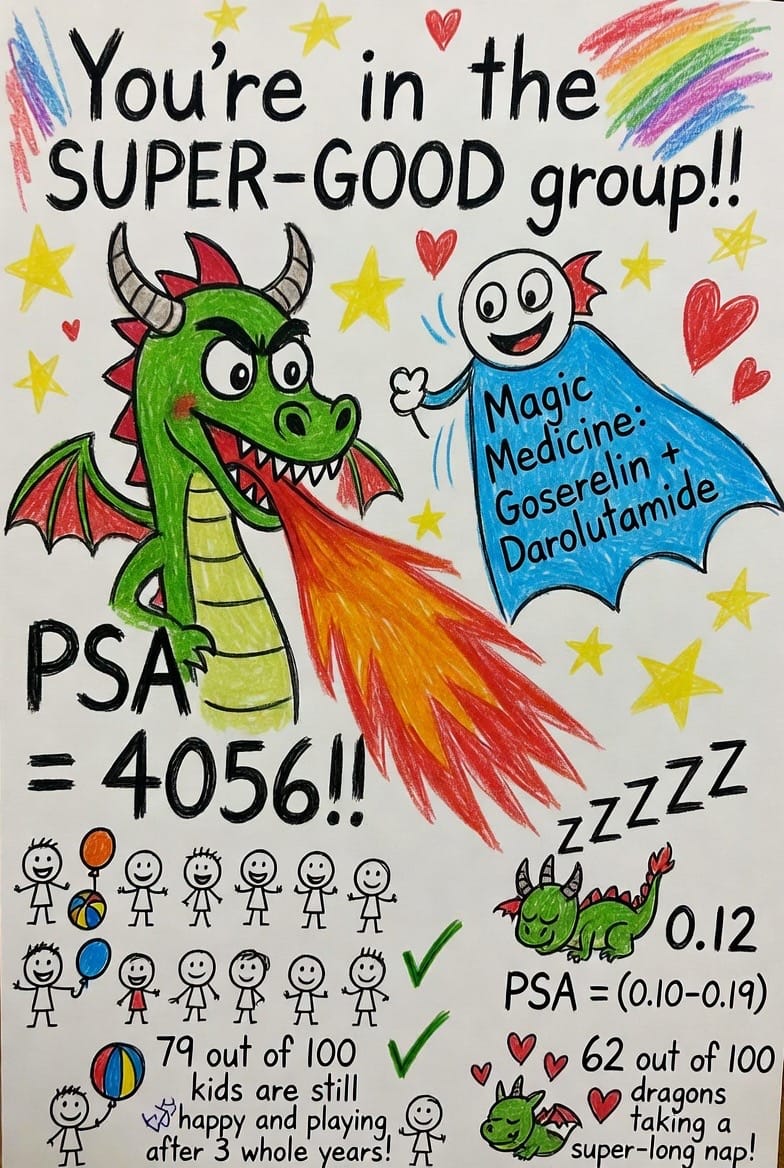
The Sleeping Dragon — a blue superhero watching over a sleeping dragon
The Sleeping Dragon. Created to explain stage IV palliative cancer — first to myself, then to my three-year-old daughter.

I’m not sharing this story for sympathy. I’m sharing it because prostate cancer is now the most commonly diagnosed cancer in the UK — and there is still no national screening programme. I had to argue with my GP for the blood test that saved my life. No man should have to do that.

Media & Speaking

A patient voice with a professional perspective.

Peter Wingrove spent a decade leading UK and international charities — raising millions, building high-performing teams, and navigating the intersection of healthcare, policy, and public advocacy. He brings that experience to everything he does as Smart As Daddy.

  • CEO, Shawmind National Mental Health Charity (2019–2024)
  • MBA, Cornell University Johnson School & UCT Graduate School of Business
  • Founded the GSB Foundation, raising £2.5 million in two years
  • Designed a £2 million annual MBA grant programme
  • Stage IV metastatic prostate cancer — Gleason 4+5, diagnosed 2025
  • PSA: 4,056 → 0.12 in 12 months, thanks to prayer and triplet therapy
  • Prostate Cancer Awareness Campaigner — UK Parliament petition 751472

Available to speak or write on:

Prostate Cancer Patient Perspective The Case for National Screening Men’s Mental Health Fatherhood & Serious Illness Navigating the NHS Palliative Care — Living With, Not Dying From What Nobody Tells You About Cancer Treatment Leadership Through Crisis

Get in Touch

If you’re a journalist, broadcaster, charity, event organiser, or policymaker and you’d like to talk — I’d love to hear from you. Whether it’s an interview, a panel, a keynote, or a collaboration, my inbox is open.

peter@smartasdaddy.com

Peter Wingrove is available for media interviews, podcast appearances, conference keynotes, charity events, and health sector panels. A full media kit is available on request.

Medical disclaimer: The content on this site reflects Peter Wingrove’s personal experience of prostate cancer diagnosis and treatment. It does not constitute medical advice. Always consult your GP or specialist healthcare team regarding your own health. Peter’s treatment pathway is palliative, not curative — his PSA numbers reflect successful disease management, not a cure.

© 2026 Smart As Daddy / Peter Wingrove. All rights reserved.